A homeowner in Westchester replaced a 20-year-old gas furnace last winter. Good contractor, fair price, clean install. No permit was ever pulled, and nothing on the quote mentioned one. Eighteen months later, a home inspector doing a pre-sale walkthrough found the flue venting terminated eleven inches from a window — well inside the clearance the fuel gas code requires. Nobody had gotten hurt yet. But the seller paid to have it corrected out of pocket, at closing, under time pressure, instead of having it caught and fixed for free during a five-minute inspection at install time.
The short answer
If a permit isn’t listed on your quote, ask directly whether the contractor is pulling one — don’t assume “no permit” means “not needed here.” In most municipalities, replacing a furnace, AC condenser, or water heater requires the same permit and inspection as installing one for the first time, because the failure modes a permit inspection catches (gas line sizing, venting clearances, electrical disconnects, condensate drainage) don’t care whether the equipment is new-to-the-house or a swap.
Why it works that way
A permit by itself does nothing. What it buys you is the inspection that comes with it — a code official, with no financial stake in the job, checking a fixed list of items an installer has every incentive to get right but no independent party checking whether they actually did. That distinction matters because install mistakes are almost always invisible from the homeowner’s side and often invisible to the installer too, at least until something fails. A furnace vents combustion byproducts outside; get the termination point wrong and the system still runs, still heats the house, and gives no sign anything is off until conditions line up badly. A gas line sized for the old, smaller furnace still delivers enough pressure to light the new, larger one — just not enough to run it at full input, which shows up as a system that “runs but never quite keeps up,” diagnosed as a lot of things before anyone rechecks the pipe sizing.
The inspection exists specifically to catch these before the house is occupied around them for years. Skipping the permit doesn’t make the underlying work better or worse — it just removes the one checkpoint that would catch it if it’s worse.
Why it gets skipped
Rarely dishonesty, usually the same incentive problem as the startup measurements in the commissioning article: a permit costs the contractor a fee that’s often not marked up, adds a scheduling delay for the inspection, and creates a small chance of a failed inspection that means going back to redo something — all real costs to the contractor, with the benefit landing entirely on a homeowner who won’t know to ask for it. A job that “looks done” the day the system turns on looks identical whether it’s permitted or not, so there’s no visible cost to skipping it until years later, at a home sale or an insurance claim, when it’s someone else’s problem to untangle.
What to ask
Ask directly: “Are you pulling a permit for this job?” Most residential jurisdictions require one for equipment replacement, not just new installs — but rules genuinely vary by municipality, so it’s worth a two-minute check of your own town or city’s building department site rather than taking either “yes, obviously” or “no, not needed” purely on faith. If the contractor says permits aren’t required for this type of work in your area, ask them to point you to where that’s stated, or check it yourself — it takes less time than getting a second quote.
Ask, too, whether the permit fee is included in the price you were quoted or added separately. A contractor who’s already built it into the number is telling you it’s a normal part of how they do the job, not an afterthought.
What a bad answer sounds like
“We do this so often, we don’t bother” describes a contractor choosing to skip a code-required inspection to save time, not a contractor telling you it isn’t required.
“Permits just slow things down and add cost for no real benefit” is a sales pitch for skipping a safety inspection, phrased as customer service.
“That’s really more of a new-construction thing” is sometimes true and sometimes a guess dressed as fact — replacement-triggers-permit rules differ by jurisdiction and by trade (gas work and electrical work often have lower thresholds than the mechanical equipment itself), so this deserves a real answer, not a shrug.
One to look at yourself
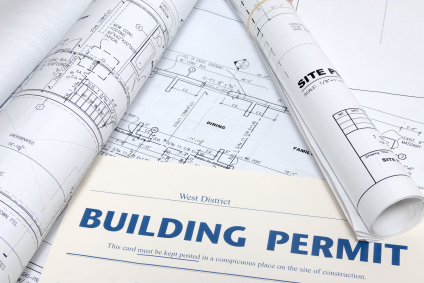
A permit and the plans it covers — not from a Read the Nameplate job, but a real one. A closed permit for your own furnace or AC changeout is one municipal permit-search lookup away, and worth checking before you sign anything.
Photo: Aavaaz home builder, CC BY-SA 4.0, via Wikimedia Commons.
