A homeowner told us his new AC was “ice cold, works great” — and then, in the next breath, that he’d bought a standalone dehumidifier for the basement because the house still felt swampy. He’d paid, in effect, for two appliances to do one job, and was pretty sure that was just how central air worked. It isn’t. It’s what happens when the AC is bigger than the house actually needs, and nobody mentioned that “bigger” and “drier” are not the same promise.
The short answer
An oversized AC cools the air fast and shuts back off before it’s had time to wring the moisture out of it. Removing humidity is a function of runtime, not horsepower — the system needs to run long enough for moisture to actually condense on the coil and drain away, and an oversized unit satisfies the thermostat and shuts off well before that happens. You end up with a house that’s cold and damp, which feels, correctly, like nothing was actually fixed.
Why bigger doesn’t mean drier
Cooling a house is really two jobs stapled together. One is dropping the air temperature — sensible heat, the number on the thermostat. The other is pulling moisture out of the air — latent heat, the number nobody puts on a thermostat but everybody feels the second it’s wrong. An AC does both at once, but on very different clocks: temperature drops fast, humidity drops slow. The coil needs sustained airflow over it, working, for a while before condensation actually beads up and runs down the drain line instead of staying suspended in your air.
An oversized system is spectacular at the fast half and never sticks around for the slow half. It blasts the room down to setpoint in a few minutes, the thermostat says “done,” and the compressor shuts off — like a runner who sprints the first hundred yards of a marathon and then stops because technically they’re ahead of pace. Repeat that every few minutes, all afternoon, and the house ends up cold, humid, and running an electric bill for equipment that’s mostly just switching on and off.
Put real numbers on it: a properly sized 3-ton system, matched to the house, might run a steady 35–40 minutes to satisfy the thermostat on a hot afternoon — plenty of coil time to pull real moisture out. A 5-ton system plunked into that same house can hit the same setpoint in 8 minutes flat. Faster is not a compliment here. It’s the reason the humidity never left the building.
There’s also a quieter reason this keeps happening: nobody ever calls a contractor back eighteen months later to complain the unit’s too big. Undersizing gets you an angry phone call in July. Oversizing gets you a slightly clammy house and a customer who assumes that’s just what central air feels like — which is a much easier mistake to walk away from.
What to ask for
A load calculation, not a tape measure and a gut feeling. The correct way to size an AC is a Manual J calculation — square footage, insulation, window area and orientation, ceiling height, local climate data, all of it, producing an actual number. The wrong way, which is unfortunately common, is “one ton per 500 square feet” or “we’ll match what you had,” neither of which accounts for anything about your specific house. That’s the mechanical-sizing equivalent of a doctor prescribing your dosage off your height and calling it a physical.
Ask to see the calculation itself, not just the tonnage it produced. If a contractor can’t produce one, or bristles at being asked, that’s useful information on its own.
Watch for the actual symptoms of oversizing, whether you’re diagnosing an existing system or sanity-checking a new proposal: short cycles (the system kicking on and off every five to ten minutes instead of running steady for a while), a house that’s cold but still clammy, big swings between rooms, and — the one that fools people — a system that seems efficient because it’s barely ever running, while the electric bill quietly disagrees. A unit that short-cycles all day is doing a lot of starting and stopping, which is its own kind of wasteful, on top of never finishing the dehumidifying job it started.
What a bad answer sounds like
“Bigger gives you a safety margin” is the classic. A safety margin against what — the one afternoon a decade your house needs slightly more cooling than calculated? That margin costs you every single day in between, in humidity and in short-cycling, in exchange for insurance you’ll almost never use.
“We always round up to the next size, just to be safe” is the same answer with less self-awareness. Rounding up from a real Manual J number by a reasonable margin is normal practice. Rounding up from a guess, as a house policy, is not sizing — it’s just guessing bigger.
“It’s blowing ice cold, what’s the problem?” answers a question about comfort with a fact about temperature. Nobody’s dehumidifier has ever complained that the air wasn’t cold enough. That’s not the part that was broken.
One to look at yourself
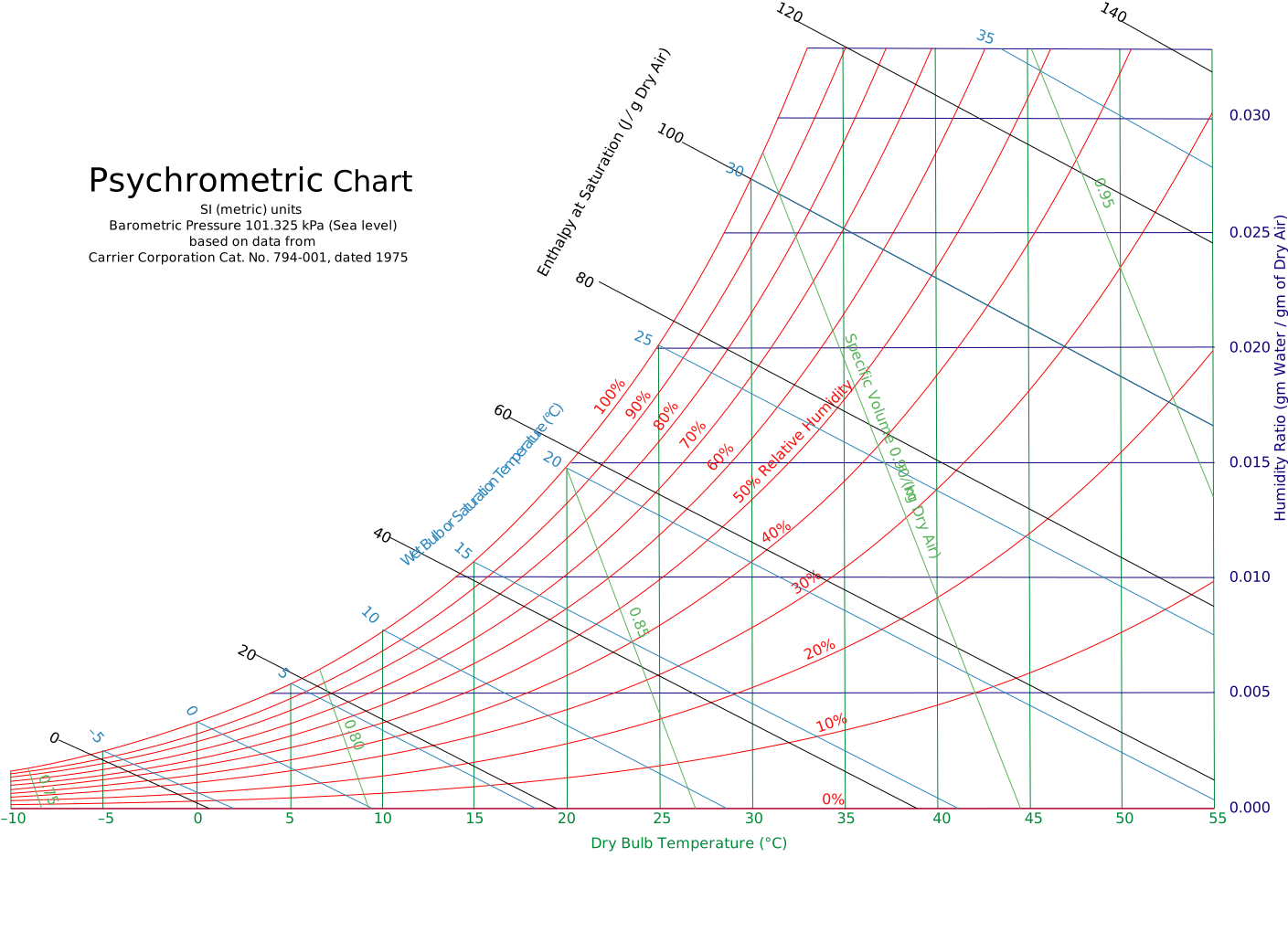
A real psychrometric chart — the tool a Manual J calculation runs on. It looks like a cross between a spreadsheet and an eye chart, but it’s the good kind of paperwork: the only document that actually proves the tonnage matches the house instead of matching a rule of thumb. This one’s in metric units; ask your own contractor for the actual Manual J printout for your house — if they hand you a real one, that’s worth more than the sales pitch that came with it.
Chart: ArthurOgawa, CC BY-SA 3.0, via Wikimedia Commons.

If your house is cold and still feels like the inside of a produce bag, the fix usually isn’t a second appliance in the basement. It’s admitting the first one was oversized, and asking the next contractor to actually do the math instead of eyeballing it and rounding up “to be safe.”